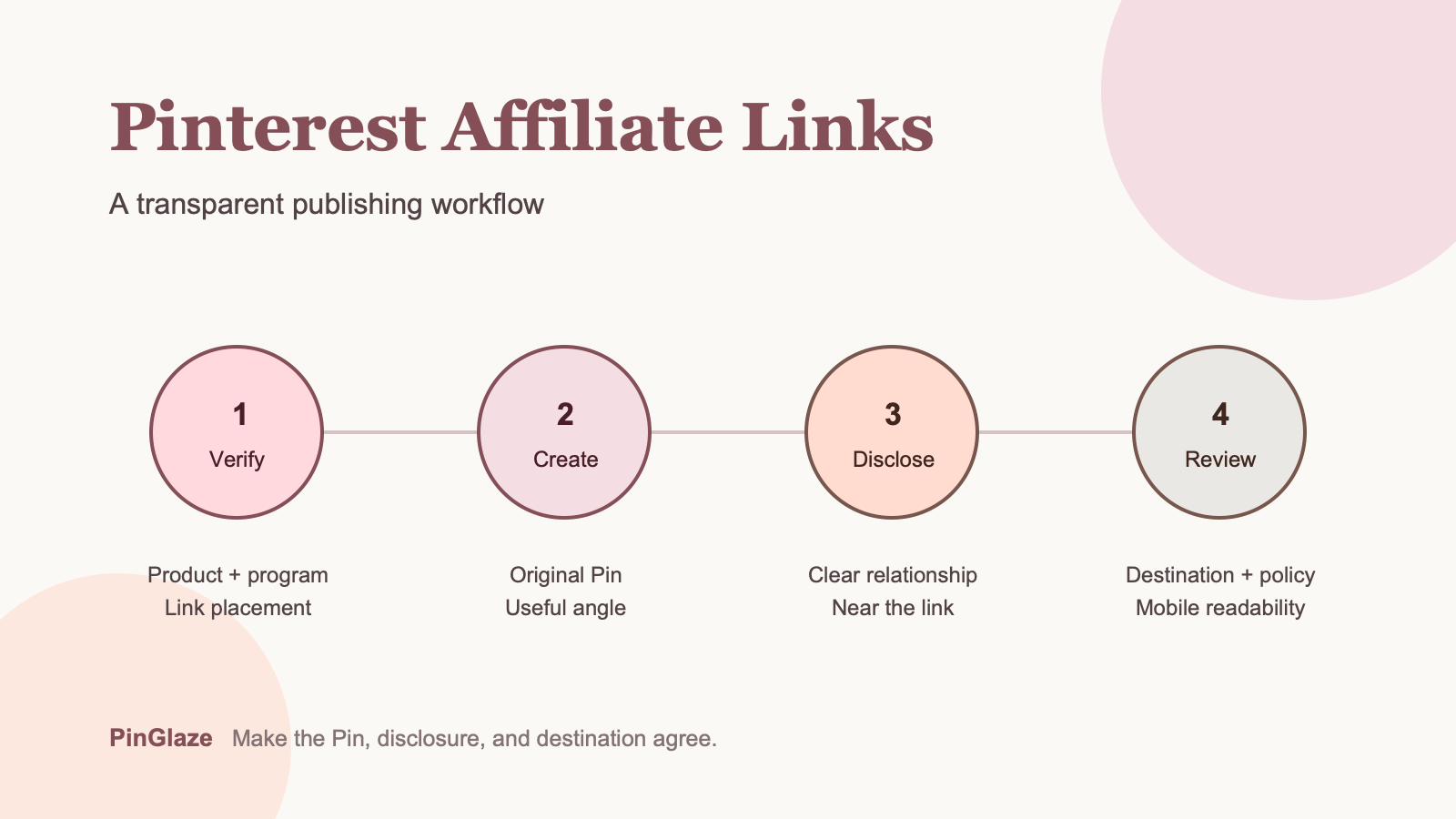
The short answer: can you use affiliate links on Pinterest?
Pinterest's current commercial content guidelines explicitly discuss affiliate links and set conditions for their use. In general, creators should use an authentic account, publish original content that adds value, explain the commercial nature and behavior of their links, and avoid manipulating distribution.
Pinterest also warns that some URL shorteners are not supported. If a Pin link is blocked, the platform says you can edit it. Test the actual destination URL instead of assuming a shortened link will work.
This guide is an operational summary, not legal advice. Check Pinterest's current policies, the terms of your affiliate program, the advertising and disclosure rules that apply where you operate, and the accuracy of the destination page on the day you publish.
Read Pinterest’s current commercial and affiliate guidelines
What Pinterest expects from affiliate content
Affiliate content should come from an authentic presence, provide original value, make the commercial relationship understandable, and avoid tactics intended to manufacture reach.
Use an authentic presence
Pinterest says affiliates should generally operate one authentic account. Fake accounts, coordinated saving, and other attempts to manufacture traffic can violate the platform's rules.
An affiliate account should have a clear topic, relevant boards, and content that helps a person make a decision or discover an idea—not thousands of nearly identical product Pins.
Add original value
A product image plus an affiliate link is not automatically useful content. Add a specific use case, a themed gift guide, a comparison criterion, a styling idea, an honest limitation, or a clear explanation of who the product is for.
The Pin should make a promise that the destination can fulfill. A small-space desk setup should not lead to an unrelated storefront, and an expired coupon should not continue circulating as a current offer.
Be transparent about the commercial relationship
Pinterest requires transparency about the commercial nature of affiliate content and how links behave. Other disclosure rules may also apply based on your location and arrangement.
The U.S. Federal Trade Commission says a material connection should be disclosed clearly and conspicuously. Its guidance explains that the closer a disclosure is to the recommendation and link, the better, and warns that affiliate link by itself may not tell ordinary consumers that the creator can receive a commission.
A plain-language example is: I may earn a commission if you purchase through this link. Use wording that truthfully describes your relationship and satisfies the rules that apply to you.
Do not manipulate distribution
Pinterest prohibits attempts to artificially manipulate its algorithms or Pinner traffic. Its examples include fake accounts, quid-pro-quo saves, and asking other people to create Pins using your affiliate identifier.
A sustainable workflow creates genuinely different and relevant ideas—not cosmetic duplicates that only swap a color or headline.
Direct affiliate link or your own landing page?
There are two common paths. Neither is automatically correct for every creator or affiliate program. Read the exact affiliate agreement before choosing.
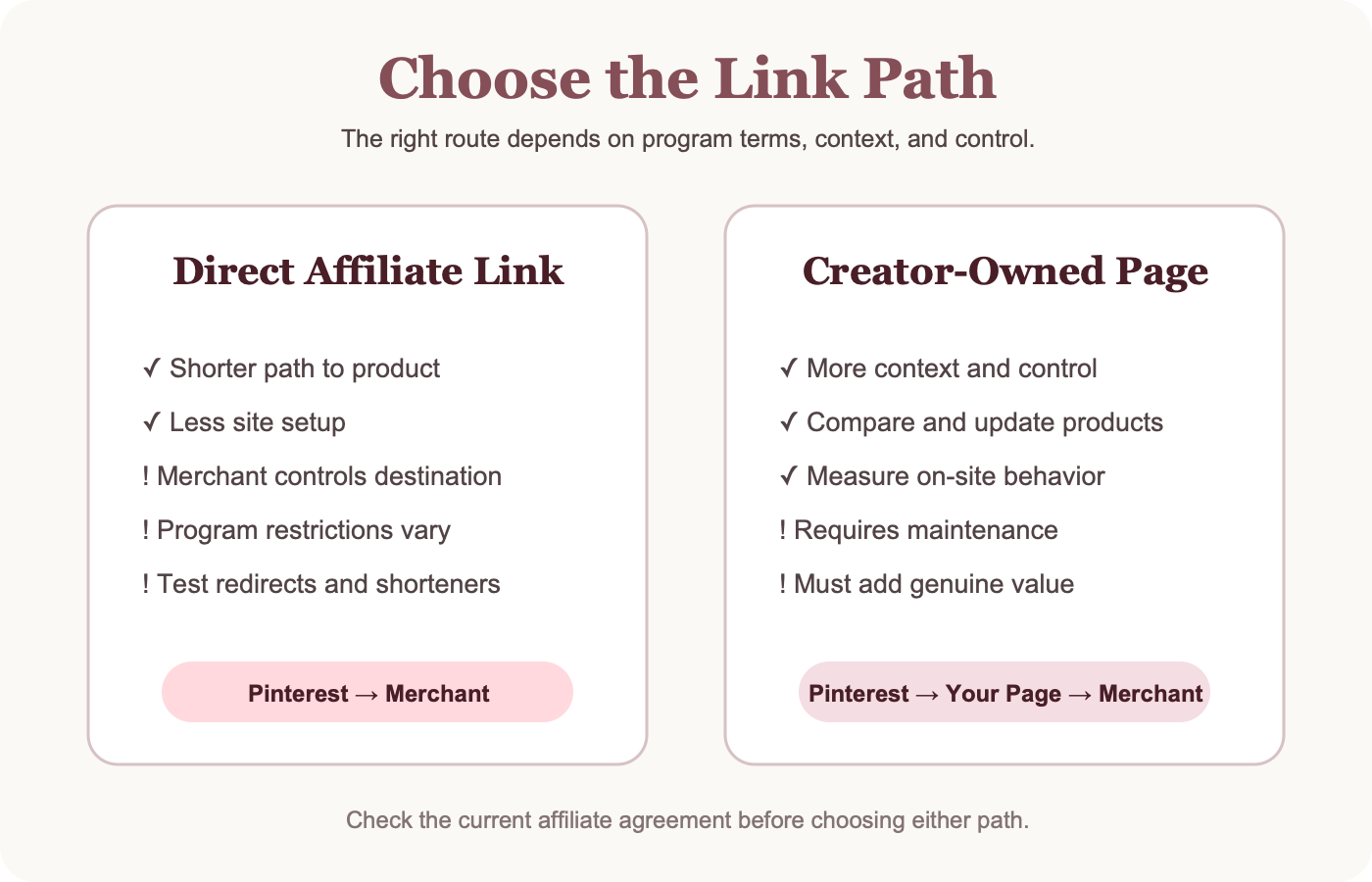
Option 1: link directly to the merchant
A direct affiliate link removes an extra click. It may suit a focused product Pin when the program allows Pinterest traffic and the link works correctly on the platform.
- Shorter path from Pin to product
- Less website setup
- The merchant controls the destination experience
- Product availability, price, and page structure can change
- Some programs restrict social link placement
- Unsupported shorteners or redirects can cause problems
Option 2: link to your own useful page
A creator-owned article or landing page can explain the recommendation, compare options, provide original guidance, and place affiliate links in context.
- More control over the message and reader experience
- Space for qualifications, comparisons, and updates
- A reusable search and email asset
- Requires a website and ongoing maintenance
- Adds another step before the merchant page
- A thin bridge page can disappoint readers
How to create a Pinterest affiliate Pin from a product link
Use one verified product, one useful content angle, and a reviewable publishing package. Automatic importing varies by website, so every field still needs human review.
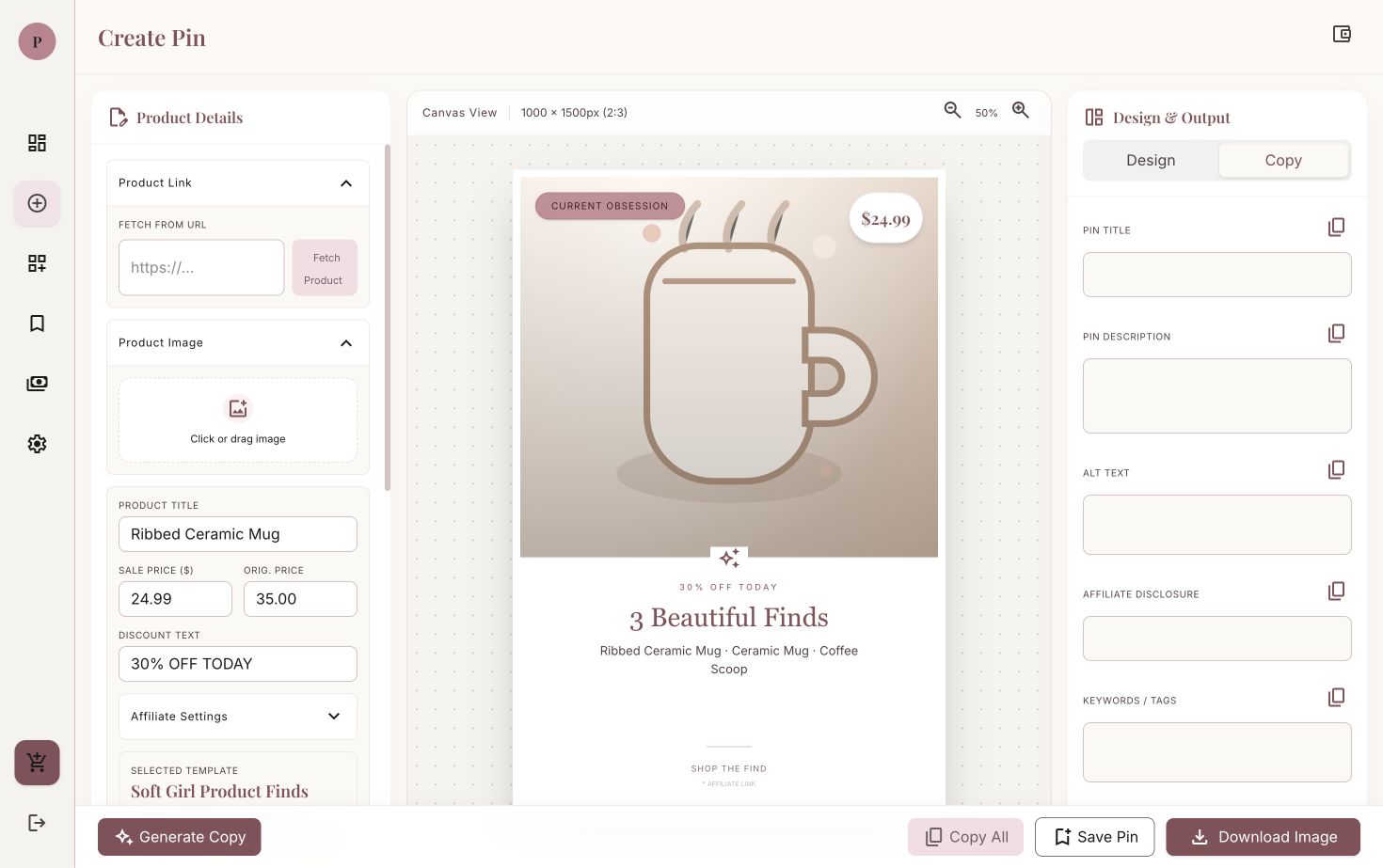
Verify the product and program first
Confirm that you are approved for the program and that Pinterest is an allowed traffic source. Check the product page, availability, price, discount, delivery limits, and every claim you plan to make.
Do not create urgency from an offer you have not verified. Record an expiry date so you can update or retire the Pin later.
Choose one useful content angle
Choose a practical product find, a gift for a defined recipient, an outfit idea, or a verified deal. A specific angle makes the visual, title, description, and destination easier to review together.
Prepare the Pin package
PinGlaze can prepare an editable Pin image, title, description, alt text, and affiliate disclosure draft. Treat imported and generated fields as a starting point, not verified facts.
Review the visual and product details
Check the product name, image, price, discount, and call to action against the destination. Make sure important text remains readable on a mobile screen. A polished Pin with an inaccurate price is still inaccurate.
Write a clear title and description
The title should identify the idea or product angle. The description should explain what someone will find after clicking without keyword stuffing, invented reviews, fake scarcity, or claims absent from the source page.
Add the destination link and disclosure
Test the intended final URL on mobile and desktop. Confirm that redirects resolve, tracking remains intact, and the destination matches the Pin. Put a plain-language disclosure where readers can notice and understand it.
Publish to a relevant board
Choose a board that accurately describes the content. Do not rely on irrelevant boards, coordinated saves, or repetitive bulk publishing to manufacture reach.
PinGlaze prepares editable assets and publishing copy. It does not automatically publish or schedule Pins to your Pinterest account.
Pinterest affiliate Pin checklist
Run this five-minute check immediately before publishing.
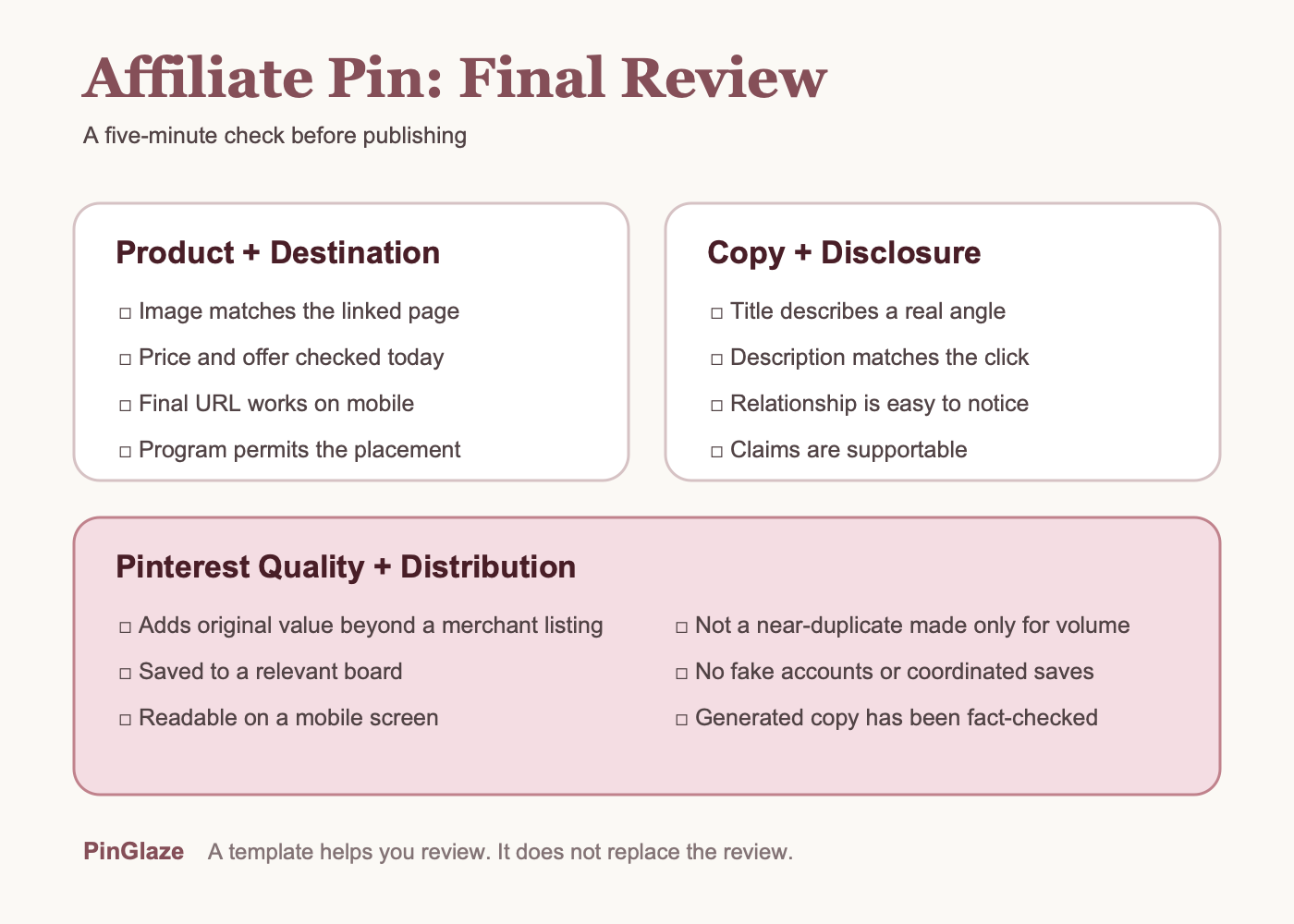
Product and destination
- The Pin image matches the linked product or page.
- Product name, price, discount, and availability were checked today.
- The destination opens correctly on mobile and desktop.
- Affiliate tracking remains intact after redirects.
- The affiliate program permits this traffic source and placement.
Copy and disclosure
- The title describes a real content angle.
- The description explains what the click leads to.
- The disclosure uses language ordinary readers can understand.
- The disclosure is close enough to be noticed.
- Claims, comparisons, and urgency are supportable.
Pinterest quality and distribution
- The Pin adds original value beyond a merchant listing.
- The Pin is saved to a relevant board.
- The creative is readable on mobile.
- This is not a near-duplicate created only for volume.
- No fake accounts or coordinated saves are involved.
- Generated copy has been fact-checked.
Common mistakes with Pinterest affiliate links
Hiding the commercial relationship
A vague label or buried disclosure makes it harder for readers to understand why the link is present. Use plain language and place it where it connects naturally to the recommendation.
Assuming every shortened link works
Pinterest says some shortener services are unsupported. Test the exact link you plan to publish and keep a record of the final destination.
Linking to a different promise
If the Pin promotes a specific product, guide, price, or code, the destination should deliver that promise. Mismatched content reduces trust and may create policy problems.
Publishing expired deals
Record expiry dates, revisit old Pins, and remove or update claims that are no longer true.
Creating repetitive affiliate Pins at scale
Changing a background color does not necessarily create a new idea. Build Pins around different real needs, recipients, use cases, or comparisons.
Treating generated copy as verified copy
Generated text is a draft. Compare every product claim, price, link, and disclosure with an authoritative source before publishing.
Frequently asked questions
Does Pinterest allow direct affiliate links?
Pinterest discusses affiliate links in its commercial content guidelines and permits them subject to authenticity, originality, transparency, moderation, and anti-manipulation requirements. Your affiliate program may add restrictions.
Can I use Amazon affiliate links on Pinterest?
Check the current Amazon Associates agreement and your approved website or social properties before publishing. A general Pinterest rule does not replace a specific program contract.
Can I use Etsy affiliate links on Pinterest?
Check the current Etsy affiliate or creator program terms, including permitted promotional methods and disclosure requirements. Program rules can change independently from Pinterest policy.
Should I use a URL shortener?
Use caution. Pinterest states that some shortener services are unsupported. Test the final URL and use a format permitted by both Pinterest and your affiliate program.
Where should the affiliate disclosure go?
Place it where it is clear, easy to notice, and connected to the recommendation and link. Applicable law, Pinterest tools, and program terms may add requirements.
Can I create several Pins for the same URL?
Create genuinely different Pins that add value through distinct angles. Avoid repetitive high-volume near-duplicates or tactics intended to manipulate distribution.
Does an affiliate Pin guarantee clicks or income?
No. Results depend on relevance, creative quality, audience fit, the destination page, product demand, distribution, and other factors outside a Pin creation tool.
Create an affiliate Pin you can review
Start with one verified product and one useful angle. Generate the visual and publishing copy, then review the destination, disclosure, and policy fit before publishing.